Teaching Reading
Phonics at Bishop Wilson CofE Primary School
At Bishop Wilson CofE Primary School, we are passionate about teaching children the skills and knowledge to become fluent readers. We encourage a love of reading through stories, shared texts, puppets and Helicopter Stories. We know that reading enables children to access all other areas of the curriculum and positively influences their future success. Therefore, at our school, reading is at the heart of all we do.
We provide rich, high-quality phonics lessons where children learn to listen carefully, speak clearly and become fluent readers and writers from an early stage.
Our Phonics Programme – Read Write Inc.
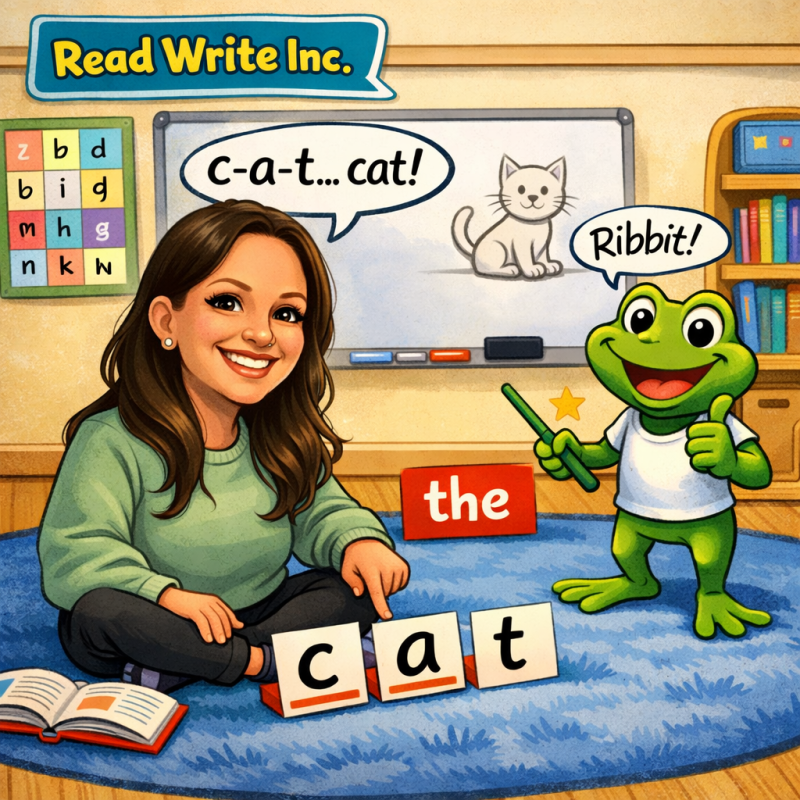
We use the Read Write Inc. (RWI) programme to teach early reading and phonics. Children begin daily phonics lessons as soon as they have settled into Reception. Usually, this is two weeks after starting in September.
In Reception, children learn to:
-
Pronounce and correctly form Set 1 sounds
-
Use pure sounds to support accurate blending
-
Blend sounds to read words
-
Segment sounds to spell words
-
Form letters correctly using rhymes to support accurate handwriting
Throughout the day, children play ‘Fred Games’, which help them to practise oral blending in a fun and engaging way. As children become confident with Set 1 sounds and can read them speedily, they move on to Set 2 and then Set 3 sounds.
Children also read ‘Alien words’ (nonsense words). This allows them to apply their phonic knowledge confidently and prepares them for the Year One Phonics Screening Check in the summer term.
Teaching for Success
Children are grouped according to their reading ability and fluency — not their age — ensuring that every child reads books that are closely matched to their current phonic knowledge. This ensures early success, builds confidence and supports steady progress.
Each half term, all children on the phonics programme are reassessed by the Reading Lead - Miss Gabriel - using the RWI online assessment system. This carefully tracks progress and identifies any children who may need additional support. We provide targeted daily interventions and one-to-one tutoring to ensure all pupils make strong progress.
We have high expectations for all children to meet the expected standard in the Phonics Screening Check and to become accurate, fluent readers by the time they enter Key Stage 2.
Developing a Love of Reading
Alongside phonics, we foster a love of reading through:
-
Daily story time
-
Shared reading
-
Puppets and storytelling
-
Helicopter Stories
-
Exposure to a wide range of fiction, non-fiction and poetry
Children take home the reading book that they have been reading for three to four days in school, along with a matched book for home. We also send home phonics videos to help families support sound recognition, blending and building fluency at home. This partnership between school and home strengthens fluency and builds confidence.
Our CERB Drivers in Phonics
Our school drivers — Communicators, Explorers, Readers and Believers (CERB) — are woven throughout our phonics teaching.
-
Communicators – Children will learn to correctly form letters when they start school in Reception. Along with learning to blend and segment words which in turn will enable them to read. Children learn to decode words and communicate through reading and writing.
-
Explorers – Children explore different sounds and spelling patterns within Phonics lessons.
-
Readers – Children become readers through well planned, fast paced lessons which enable children to become fluent and confident readers.
-
Believers – Children are encouraged to believe in themselves and provided with the tools to decode words that are tricky.
Working in Partnership with Parents
Each year, we welcome parents into our phonics lessons and offer opportunities for families to learn more about how we teach phonics. We encourage parents to explore the Read Write Inc. parent resources available on the Ruth Miskin website.
By working together, we ensure that every child develops the skills, confidence and love of reading needed to thrive — both now and in the future.
We are committed to ensuring that every child becomes a confident reader, including those with additional needs. Where children require further support, we work closely with our SENDCo and families to provide tailored interventions and targeted teaching strategies. Adaptations are carefully planned within phonics lessons to ensure all children can access learning and make progress. For children with English as an Additional Language (EAL), we place a strong emphasis on developing vocabulary and language comprehension alongside decoding skills. Our inclusive approach ensures that all pupils are supported to succeed and develop a lifelong love of reading.
Files to Download